
A real conversation
You sit down privately with one of our doctors to talk about your health history, your symptoms and what you have already tried.
Upper cervical chiropractic is a specialized area of chiropractic that focuses on the top two bones of the neck, the atlas (C1) and the axis (C2), where the brain meets the spinal cord. Instead of popping or twisting, an upper cervical chiropractor uses precise measurements and a gentle touch to correct misalignments in this area, with the goal of restoring balance to the spine and nervous system.

 123
The upper cervical region is the very top of the spine. It includes the base of the skull and the first two vertebrae, C1 and C2. C1 is called the atlas, named after the Greek god who held up the world. The name fits, because this small, donut-like bone holds up your head.
Heavy, and balanced on a very small base.
The top bone of the spine, where the head and neck meet.
Carries the head down to the shoulders.
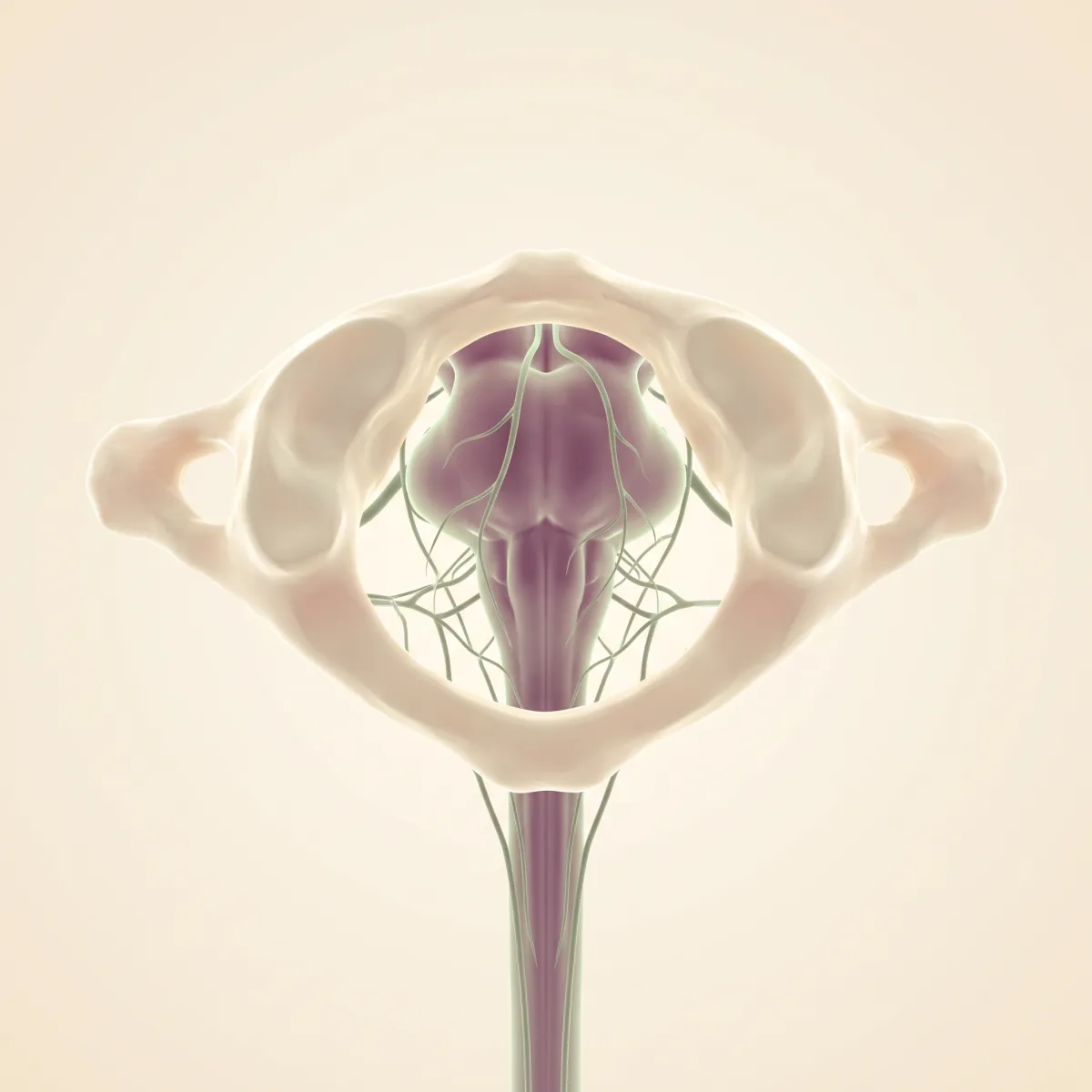
The upper cervical spine protects the brain stem, the area where the brain meets the spinal cord. It is one of the highest neurological control centers of the body, including the control of posture.
The nerves in the spinal column are very sensitive to pressure and stress. When a misalignment (also called a subluxation) stresses these nerves, the flow of information between the brain and the body can be compromised. The nervous system may sense the imbalance and shift into a defensive “fight or flight” state. In the short term that is useful. Left unchecked for a long time, it can wear on the body.
An upper neck misalignment may contribute to symptoms such as neck pain, headaches, migraines and vertigo. Upper cervical care does not treat a disease. It addresses the misalignment that may be part of the problem.
Upper cervical chiropractors are general chiropractors with specialized knowledge of the upper neck. A regular adjustment works for many people. Upper cervical care is for people who want, or need, a gentler and more precise approach.
The area between the head and neck, as the entry point to the whole spine
Adjustments to certain areas of the body
Precise calculations, specific biomechanics and gentle leverage
May pop or twist the area being adjusted
Typically no twisting, turning or popping
The well-known pop or crack is often part of care
Often includes X-rays of the neck and nerve testing such as thermography and surface EMG
Varies by office
Additional education and training on top of general chiropractic
General chiropractic education
Upper cervical chiropractic is a general term for the 8 to 10 methods that focus on the alignment of the upper neck. Quantum Spinal Mechanics 3, or QSM3, is the one our doctors use.
QSM3 was developed by Dr. Russell Friedman, who built on NUCCA and Orthospinology. It looks at the whole body in three dimensions, not just one bone. Gentle release sequences at the neck are designed to let a spine that is “breaking down” under trauma and gravity return to a more upright, stable position.
Each correction is planned with laser-aligned X-rays, and post-correction X-rays verify it.
Learn more about the method at QSM3.com.
Many new patients feel a bit anxious before their first visit. Here is what happens, step by step.
You sit down privately with one of our doctors to talk about your health history, your symptoms and what you have already tried.
If upper cervical care may help, the doctor checks your posture, biomechanics and spinal range of motion, runs computerized nerve testing and takes any X-rays needed, right in our office.
At a follow-up visit we review your results and answer four questions: what is wrong, can we help, how long will it take and how much are the fees. Then you decide.
You stay fully clothed and lie on your side. The doctor gently contacts the top of your neck with small, precise movements most patients barely feel.
Patients from babies to seniors come to us. These are some of the most common reasons. Upper cervical care may help when an upper neck misalignment is contributing to the problem.

Spinning, dizziness and balance problems.

Vertigo, ringing in the ear and ear pressure.

Frequent head pain that keeps coming back.

Sudden, shock-like facial pain.

Symptoms that linger after a head injury.

Including herniated discs, pinched nerves and sciatica.

Just a precise, gentle correction at the top of the neck, measured before and verified after.
Prefer to watch? This short video explains upper cervical care and why the top of the neck gets so much attention.
Have a question about your own situation? Call or text us at 732-617-9355.
Still wondering? Call or text us at 732-617-9355.

On the surface, all chiropractic care may appear to work similarly — patients receive adjustments to fix spinal misalignments. While the well-known...
Read article
If you’re considering a trip to Monmouth County, NJ to take advantage of Upper Cervical Chiropractic of Monmouth’s complimentary consultation, you...
Read article
If you have a condition or injury that causes spinal pain, you understand how severely the discomfort can impact your quality of life. Fortunately,...
Read article
Book your first visit online, or call or text us at 732-617-9355.